



Why Excavator H-Link and Link Rod Quality Matters in Heavy-Duty Operations

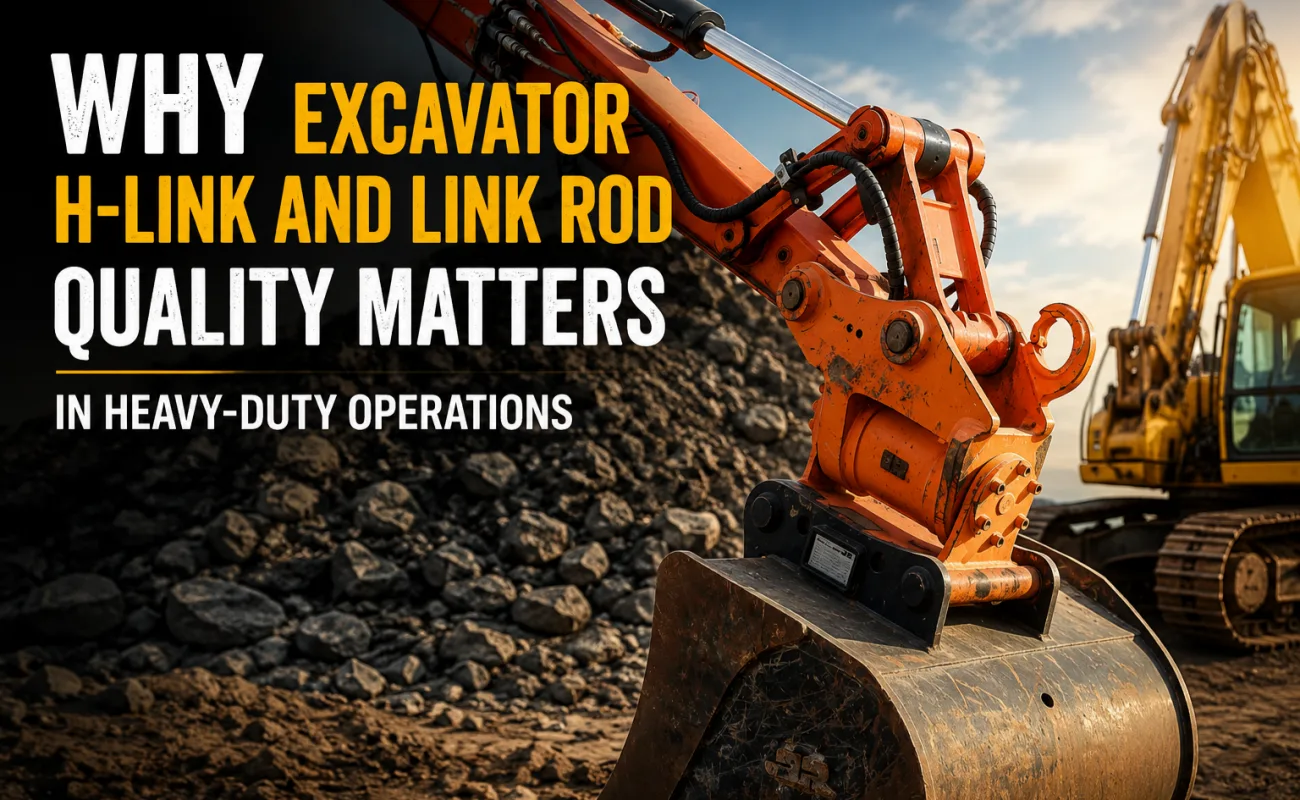
In excavator front-end working devices, many users focus on the hydraulic cylinders, bucket, or boom itself. However, the truly crucial components responsible for connecting and transmitting digging force are often the H-Link and the Link Rod (dog bone). For excavators operating in mines, quarries, and heavy earthmoving environments, the H-Link and Link Rod not only continuously withstand high-load impacts but also frequently experience high-intensity reciprocating motions. Therefore, their material strength, welding stability, and machining precision directly affect the stability of the bucket's movement and the lifespan of the entire front-end working device.
In recent years, more and more overseas customers have begun to pay attention to products such as excavator H-Link, bucket linkage systems, and heavy-duty excavator link rods. Compared to the past focus on simple size matching, more customers are now emphasizing structural strength and manufacturing processes.
Function of the H-Link and Link Rod
In excavator working devices, the H-Link and Link Rod are actually "force transmission structures." The force output by the hydraulic cylinders does not directly act on the bucket; instead, it is transmitted and amplified through the strut and connecting rod structure to complete the bucket's tilting, digging, and unloading actions.
Simply put, these components not only connect the various moving parts but also bear a significant load.
Especially under heavy-load conditions, when the equipment is digging in hard rock or performing high-impact operations, the strut and connecting rod area often continuously bears:
- High torque loads
- Impact stress
- High-frequency reciprocating motion
- Off-center loading and vibration
Therefore, although these components are not as "obvious" as the engine, they directly affect the overall stability of the machine.
Connecting Rods in Mining Operations
Compared to ordinary earthmoving, the digging resistance in mining and quarrying conditions is significantly higher.
Under continuous high load conditions, the connecting rod and pin area will be subjected to strong impacts for extended periods. If the material strength is insufficient or the hole machining accuracy is unstable, under high-intensity operation, link rod deformation, increased pin clearance, and cracks in the welded areas are likely to occur. Many machines experience severe bucket wobbling after years of use, which is often not just a pin problem, but is frequently related to wear on the swing frame, connecting rods, and connecting holes.
Especially for large mining excavators, if the clearance in the front-end connecting structure continues to widen, it will not only affect the accuracy of operation but also further increase the load on the cylinders and structural components.
The Importance of Materials and Forging Processes
For high-load structural components, material strength directly affects service life. Many high-quality swing frames and connecting rods use high-strength steel, combined with forging or reinforced welding processes, to improve overall impact resistance.
Compared to ordinary structural components, forging improves the internal flow lines of the metal, making the material structure denser, thereby improving crack resistance. This is especially important for equipment operating under heavy loads for extended periods.
At the same time, welding quality also affects overall stability. Because the swing frame structure typically withstands complex stresses, insufficient welding stress control can lead to fatigue cracks gradually appearing under high-load conditions.
Therefore, for professional engineering machinery manufacturing, truly stable structural components depend not only on the materials themselves but also on the overall manufacturing process.
The Impact of Machining Accuracy
Besides material strength, the machining accuracy of the holes is also a crucial factor affecting the lifespan of the connecting rod system.
Because the H-link and connecting rod need to form a mating structure with pins, bushings, and cylinders, excessive deviations in hole dimensions can lead to:
- Uneven stress on the pins
- Swaying of the bucket operation
- Abnormal wear
- Increased noise and vibration
Especially in modern large excavators, the operating frequency of the working device is increasing, and the requirements for structural fit accuracy are becoming increasingly stringent.
Therefore, more and more high-quality structural components are now manufactured using CNC machining to improve hole consistency and assembly stability.
Structural Component Quality is Gaining Importance
In the past, many users focused more on appearance and price when purchasing H-link and link rod.
However, as mining equipment becomes larger and the workload increases, more and more customers are realizing that what truly affects the lifespan of the front-end working device is not just "whether it can be installed," but its ability to withstand complex working conditions over a long period.
Especially for heavy-duty construction equipment, a linkage system with insufficient structural strength or unstable machining accuracy will not only increase maintenance frequency but may also affect the overall construction efficiency. Therefore, long-term stability has become a more important procurement criterion than short-term low prices.
KINTON PARTS H-Link and Link Rod
For excavator working devices, while the H-Link and the Link Rod may not be as easily noticed as the engine or hydraulic system, they directly affect the stability of bucket movement and the lifespan of the entire machine structure. From material selection to welding processes and subsequent CNC machining, every step affects the final performance.
At KINTON PARTS, we continuously provide global customers with a variety of engineering machinery structural and chassis component solutions, including H-Link, Link Rod, bucket pins, bushings, and various excavator working device accessories. Through stable material control and mature manufacturing processes, we are committed to helping customers improve equipment reliability and reduce long-term maintenance costs under heavy-duty conditions.


