How Excavator Pump Solenoid Valves Affect Hydraulic Performance
In modern excavator hydraulic systems, when equipment exhibits sluggish movement, stalling, inconsistent operation, or abnormal fuel consumption, many users immediately suspect wear or performance degradation in the main hydraulic pump. However, in actual maintenance, these problems don't always originate from the main pump's internal structure. Key electronic components in the hydraulic control system can also directly affect the overall machine's operating status. For medium and large excavators using electro-hydraulic systems, the pump proportional solenoid valve is a crucial component. It not only participates in main hydraulic pump displacement regulation but also affects hydraulic response speed, engine load matching, and overall machine movement coordination. If solenoid valve malfunctions, the equipment may experience inconsistent movement speed, unstable power output, or even decreased fuel efficiency.
The Role of the Pump Proportional Solenoid Valve
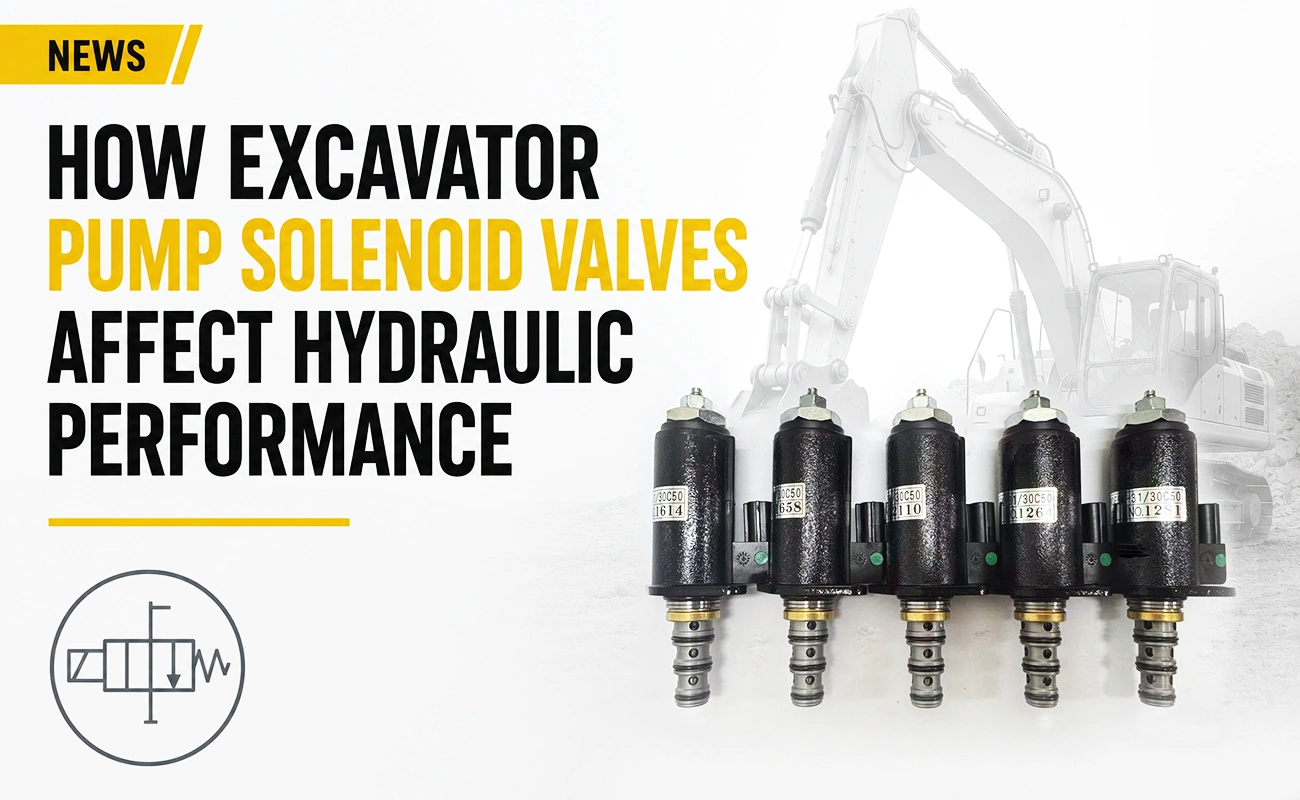
In a variable displacement piston pump system, the main hydraulic pump does not maintain a constant flow output but needs to adjust its displacement in real time according to the equipment's operating conditions. This adjustment process largely depends on the regulator solenoid valve. The solenoid valve adjusts the pilot oil pressure based on feedback signals from the ECU or hydraulic system, thereby changing the swashplate angle and ultimately controlling the main pump's output flow. Simply put, it helps the hydraulic system "determine how much flow and power is currently needed."
When the equipment is under light load, the system reduces the main pump displacement to decrease engine power consumption; while under heavy-duty excavation, it increases the flow output to ensure operating force and efficiency.
Therefore, although the solenoid valve is small, it directly affects:
- Main pump displacement adjustment
- Action response speed
- Engine load matching
- Fuel economy
- Coordination of complex actions
For modern electro-hydraulic systems, it is no longer just an ordinary control component, but a crucial coordination node between the hydraulic system and the engine.
The Overlooked Solenoid Valve Problem
In actual maintenance, many users, upon discovering that the excavator is not moving smoothly, usually suspect wear on the main hydraulic pump first.
However, in reality, a malfunction in the solenoid valve on the regulator can also cause similar behavior. This is because if the solenoid valve feedback is abnormal, the valve core is stuck, or the control signal is unstable, the main pump displacement adjustment may deviate. At this point, even if the main hydraulic pump's internal mechanical structure is not severely worn, the equipment may still exhibit abnormal operation. Especially in electro-hydraulic systems, control precision directly affects the main pump's response speed. Therefore, many problems that appear to be "hydraulic pump malfunctions" actually originate in the regulating control section.
The Impact of Hydraulic Oil Contamination
Compared to ordinary hydraulic components, the internal oil circuit of the main pump proportional solenoid valve is more precise and requires higher hydraulic oil cleanliness.
If metal particles, sludge deposits, or filter blockage persist in the hydraulic system, the valve core's sensitivity will gradually decrease. Especially in high-temperature environments, impurities produced by oil oxidation will further affect the internal sliding structure.
Many solenoid valve failures are not initially due to electrical component damage, but rather to internal oil circuit contamination. As the valve core's operation becomes unstable, the main pump's displacement control will gradually become abnormal. Therefore, for excavators, hydraulic oil management is not only about protecting the hydraulic pump but also the entire control system.
Solenoid Valve Matching Requirements
The hydraulic pump proportional solenoid valve is not a simple, universal component.
Different brands and models of hydraulic pumps may have different control logic, current parameters, and feedback methods. Even if they look similar, mismatched parameters can cause the main pump to malfunction, resulting in errors such as error codes, abnormal operation, or engine power control errors.
Therefore, relying solely on installation dimensions to determine the correct solenoid valve replacement is often unreliable. Truly stable matching usually requires confirmation based on the main pump model, equipment model, and control system parameters.
The Importance of Hydraulic Control Systems
In the past, many users focused more on the engine and the main hydraulic pump itself. However, with the increasing prevalence of electro-hydraulic systems, the importance of control systems is constantly rising.
For modern excavators, what truly determines operating feel and fuel efficiency is often not just the size of the main pump, but the precision of the entire hydraulic control system. The pump proportional solenoid valve is a crucial part of this hydraulic control chain. Although it's a small control component, it directly affects the hydraulic system's response speed, power distribution, and overall machine coordination.
Conclusion
In modern excavator hydraulic systems, the pump proportional solenoid valve, though small in size, has a very direct impact on the main pump's displacement adjustment, action response, and overall machine power matching. For equipment operating under high loads for extended periods, a stable control system directly affects construction efficiency and hydraulic system reliability.
At KINTON PARTS, we continuously provide construction machinery customers with hydraulic system accessories and solutions, including hydraulic pumps, solenoid valves, seals, and various hydraulic component support. Through stable product matching and professional spare parts services, we are committed to helping customers improve equipment operating efficiency and reduce long-term maintenance costs.