Product Applications

Excavator Hydraulic Pumps: How They Affect Performance and Reliability

Excavator Hydraulic Pumps for sale

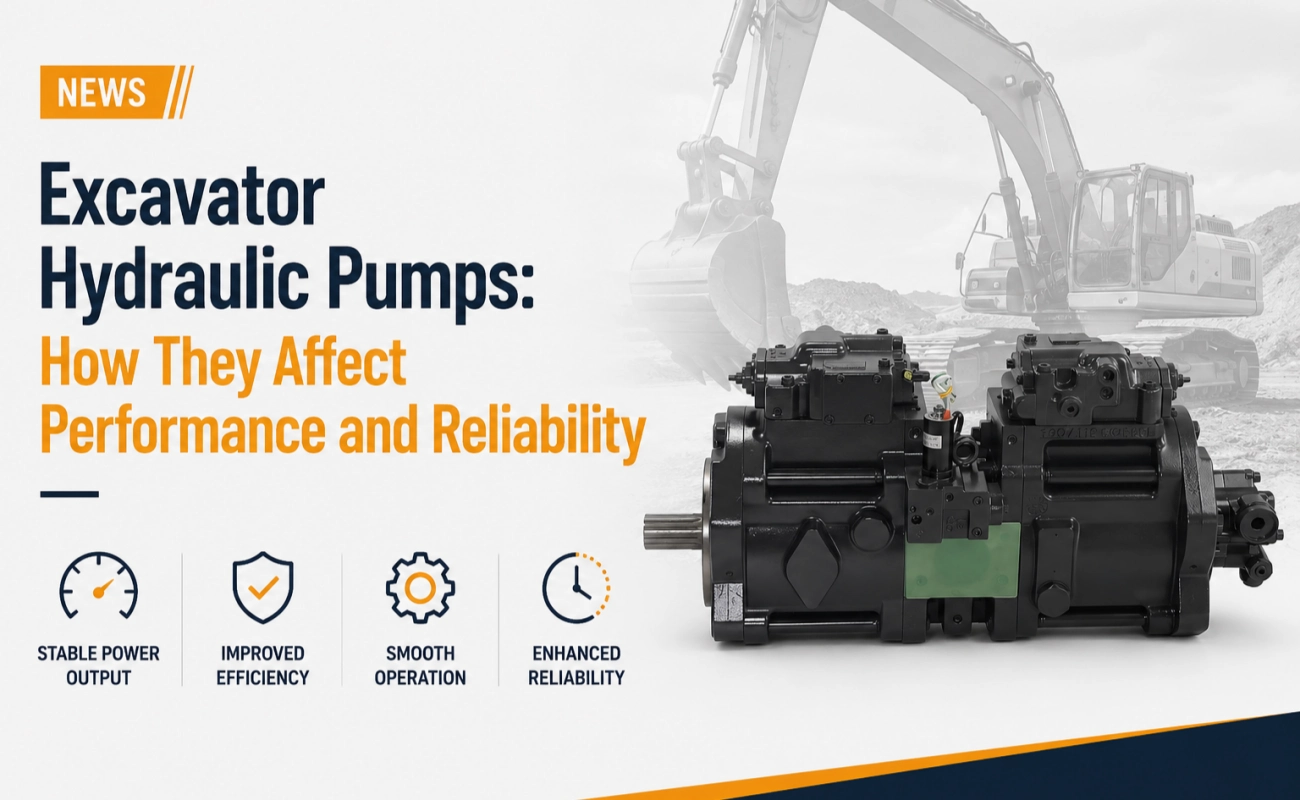
In modern excavator hydraulic systems, the hydraulic pump is often considered the "power core" of the entire system. Whether it's boom lifting, stick extension/retraction, swing motion, or travel drive, almost all hydraulic actions rely on the excavator hydraulic pump to continuously provide stable flow and pressure. Therefore, when the equipment begins to exhibit slow movement, lack of power, uncoordinated compound movements, or abnormally high oil temperature, many problems ultimately point to the hydraulic pump itself. For construction machinery operating under high loads for extended periods, the working condition of the hydraulic pump often directly determines the overall construction efficiency and system stability.

The Hydraulic Pump is More Than Just a "Supply Component"

Many users simply understand the hydraulic pump as a component that "pumps hydraulic oil out," but in reality, its role in the hydraulic system is far more complex than imagined.

The hydraulic pump needs to continuously adjust its output flow and pressure according to changes in equipment load to ensure coordinated operation of the entire machine. Especially in modern medium and large excavators, variable displacement piston pumps have become the mainstream configuration. Compared to traditional structures, it can automatically adjust its displacement according to working conditions, reducing energy loss while ensuring power output.

Especially in complex operating conditions, such as simultaneous slewing and boom lifting, the hydraulic pump's flow distribution capability directly affects the operator's feel and the smoothness of movement.

High Value Repair Parts For Hydraulic Pumps

Compared to ordinary hydraulic components, hydraulic pumps have a more sophisticated internal structure. They contain multiple high-precision components such as plungers, cylinders, distributor plates, swashplates, and servo control mechanisms, and operate under high pressure and high speed for extended periods.

Under these conditions, the hydraulic oil not only transmits power but also provides internal lubrication and heat dissipation. If the oil becomes contaminated, lubrication is insufficient, or the temperature rises abnormally, wear will gradually appear on the internal contact surfaces.

Many hydraulic pump failures do not occur suddenly but are the result of long-term, cumulative internal wear. Initially, it may only be a slight slowdown in movement, but as internal leakage increases, it will eventually develop into insufficient pressure, increased noise, or even complete machine weakness.

This is why hydraulic pumps are typically considered high-value, high-requirement core components in construction machinery maintenance.

The Impact of Hydraulic Oil Cleanliness

In actual use, many users overlook the importance of hydraulic oil management.

However, for piston pumps, metal particles, dust, and even moisture in the hydraulic oil will continuously wear down the contact surface between the piston and the distributor plate. Because the internal clearance is already very small, this micro-wear will gradually expand, eventually leading to internal leakage and decreased efficiency.

Many devices often have the following problems before hydraulic pump issues arise:

  • Hydraulic oil not changed for a long time
  • Clogged filter element
  • Severe oil contamination
  • Metal shavings inside the hydraulic system

Therefore, to some extent, the condition of the hydraulic oil is a direct reflection of the hydraulic pump's lifespan.

High Temperature Situation

Many users ignore the problem of continuously rising hydraulic oil temperature when the equipment is still working normally.

But in reality, high temperature often indicates abnormal energy loss within the hydraulic system. As internal wear of the hydraulic pump increases, internal leakage will continue to increase, and the energy originally used for power output will gradually be converted into heat.

As temperatures rise, the lubricating performance of hydraulic oil further declines, creating a vicious cycle. This is why many hydraulic pumps exhibit noticeable weakness when warmed up at high temperatures.

Therefore, abnormal oil temperature is not merely a heat dissipation issue; it is often a significant indicator of hydraulic pump wear.

Hydraulic Pump Compatibility

During maintenance and replacement, hydraulic pumps are not simply "universal parts." The parameters of hydraulic pumps can vary significantly between different brands, models, and even years of equipment.

Besides their appearance and structure, displacement, control methods, and electronic control system compatibility all affect actual performance. If parameters are incompatible, even if installation is possible, problems such as abnormal operation, increased fuel consumption, or system instability may occur.

Therefore, truly stable hydraulic pump compatibility usually requires comprehensive confirmation based on the equipment model, pump model, and control system configuration, rather than relying solely on visual inspection.

Overall Maintenance of Hydraulic System

In the past, many equipment maintenance efforts focused more on the engine, but now more and more users are realizing that the hydraulic system directly determines the excavator's operating efficiency.

Especially for modern medium and large-sized equipment, the hydraulic system not only affects operating speed but also fuel efficiency, the coordination of complex movements, and long-term maintenance costs.

Therefore, hydraulic pump condition management has gradually become a key aspect of equipment maintenance.
Conclusion

For excavators, the hydraulic pump is not only the power source of the hydraulic system but also a core component affecting overall machine performance and construction efficiency. From flow output to pressure control and movement coordination, the hydraulic pump's operating status directly impacts the overall operational performance of the equipment.

At KINTON PARTS, we continuously provide construction machinery customers with hydraulic system-related accessories and solutions, including hydraulic pumps, seals, and various hydraulic component support. Through stable product matching and professional parts services, we are committed to helping customers improve equipment operational stability and reduce long-term maintenance costs.