


How “Fan-Shaped Wear” on Cat D8T Sprocket Segments Reveals Undercarriage Misalignment

In the undercarriage system of large bulldozers, sprocket segments play a critical role in transmitting torque from the final drive to the track chain. For heavy machines such as the Cat D8T and D8R, sprocket segments must withstand enormous traction forces while maintaining stable engagement with the track links during long periods of high-load operation.
Experienced equipment owners and technicians often assess the health of the undercarriage simply by examining the wear pattern on the sprocket teeth. One particularly telling pattern is known as “fan-shaped wear.”
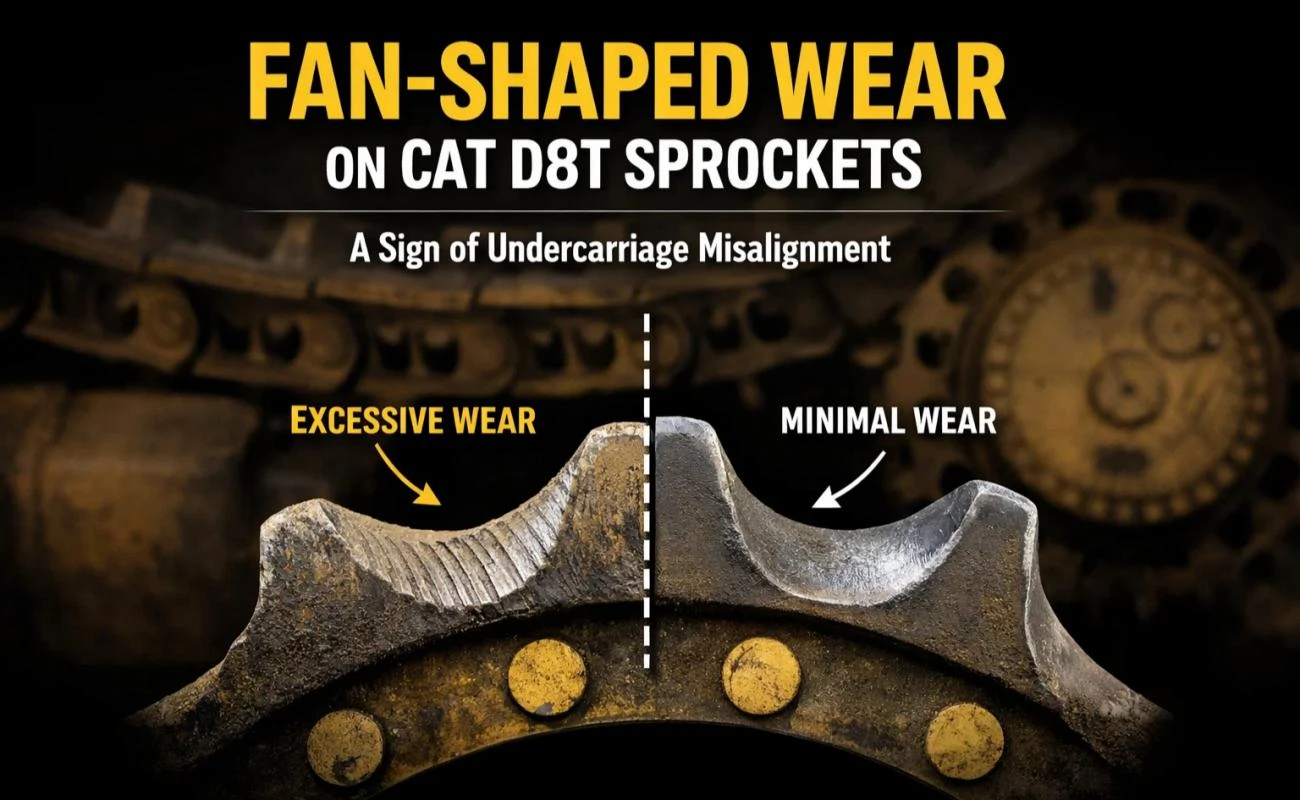
In this condition, the teeth wear significantly faster on one side or within a certain angular range, while the opposite side remains relatively intact. This asymmetrical wear pattern is often an early warning sign that the undercarriage is running slightly off alignment.
What Is “Fan-Shaped Wear” on Sprocket Segments?
Normal Wear Pattern
Under normal operating conditions, the engagement force between sprocket teeth and track links should be relatively uniform.
As operating hours increase, the tooth tips and flanks gradually become rounded due to friction and load, but the wear should remain evenly distributed across the entire tooth surface.
Abnormal Wear Pattern
When fan-shaped wear occurs, the wear becomes clearly directional. Typical signs include:
- One side of the sprocket tooth becoming noticeably thinner
- Deeper wear concentrated near the tooth root area
- A visible wear zone forming within a specific angular range of the segment
This pattern usually indicates changes in the load path within the undercarriage system, rather than problems with the material quality of the sprocket segments themselves.
Why Root-Side Wear Often Indicates Undercarriage Misalignment
Key Components That Maintain Track Alignment
On heavy bulldozers like the Cat D8T or D8R, the track system relies on several components working together to maintain straight movement:
- Front Idler
- Track Rollers
- Carrier Rollers
- Track Tensioning Assembly
If any of these components experience uneven wear, axis deviation, or incorrect tension, the track chain may begin to shift slightly sideways during operation.
How Misalignment Changes Tooth Contact
Even a small lateral deviation can alter the contact angle between the track links and the sprocket teeth. When this happens, one side of the tooth begins to carry a higher contact load.
Over time, the overloaded area—usually near the tooth root—experiences accelerated wear. This is why asymmetrical root wear is often a strong indicator that the undercarriage is running slightly off center.
Why Heavy Bulldozers Amplify the Problem
Compared with excavators, bulldozers operate under significantly higher traction loads. Machines like the D8T generate immense pushing force during earthmoving and dozing operations.
Higher traction forces mean:
- Greater contact pressure between sprocket teeth and track links
- Faster development of localized wear if load distribution becomes uneven
- Small alignment errors quickly turning into noticeable wear patterns
In harsh environments such as rock quarries, mining sites, or heavy dozing operations, the track system is also subjected to constant shock loads. Under these conditions, even minor alignment deviations can lead to visible sprocket wear differences within a few hundred operating hours.
For this reason, regularly inspecting the shape and distribution of sprocket wear is one of the most effective ways to evaluate undercarriage health.
Why Root-Side Wear Often Indicates Undercarriage Misalignment
Experienced technicians typically examine several key indicators when inspecting bulldozer sprocket segments.
- Check for Left-Right Wear Symmetry
If one side of the tooth becomes noticeably thinner, it may indicate that the track chain is shifting sideways during operation. - Examine the Tooth Root Area
The tooth root carries the highest stress during engagement.
Localized “scooping” wear or deep root erosion usually means the track link is entering the sprocket at an improper angle. - Evaluate Track Tension and Idler Position
Improper track tension can also change the load direction when track links engage with the sprocket. Checking the tensioning system and idler alignment is therefore essential when abnormal wear is detected.
Stronger Forged Sprocket Segments for Long-Term Durability
For bulldozers operating continuously in heavy-load environments, the material and manufacturing quality of sprocket segments is equally important.
High-quality segments must combine:
- High hardness for wear resistance
- Good toughness for impact resistance
- Strong fatigue resistance in the tooth root area
KINTON PARTS offers forged sprocket segments manufactured from high-strength alloy steel. Through forging and controlled heat treatment processes, the internal grain structure becomes denser and stronger, significantly improving fatigue resistance at the tooth root.
This allows the segments to maintain stable engagement with the track chain under heavy loads and helps slow the progression of abnormal wear patterns.
For large bulldozers such as the Cat D8T and D8R, these high-strength segments can provide longer service life and more reliable performance in demanding working conditions.
Reading Undercarriage Health Through Wear Patterns
Undercarriage problems rarely appear suddenly as mechanical failures. More often, they first reveal themselves through subtle changes in wear patterns.
Asymmetrical “fan-shaped” wear on sprocket segments is one of the most important early indicators.
If operators notice this pattern during routine inspections, checking the alignment of the undercarriage components early can help prevent more serious track chain damage or excessive final drive loads.
If you need assistance confirming sprocket segment specifications or undercarriage compatibility for Cat D8T, D8R, or similar models, feel free to provide the machine model or part numbers.
KINTON PARTS offers high-durability undercarriage components and supports worldwide delivery.