Company News

Track Pin Shear Strength in D10 & D11 Bulldozers: How to Prevent Track Chain Failure

Prevent Track Chain Failure

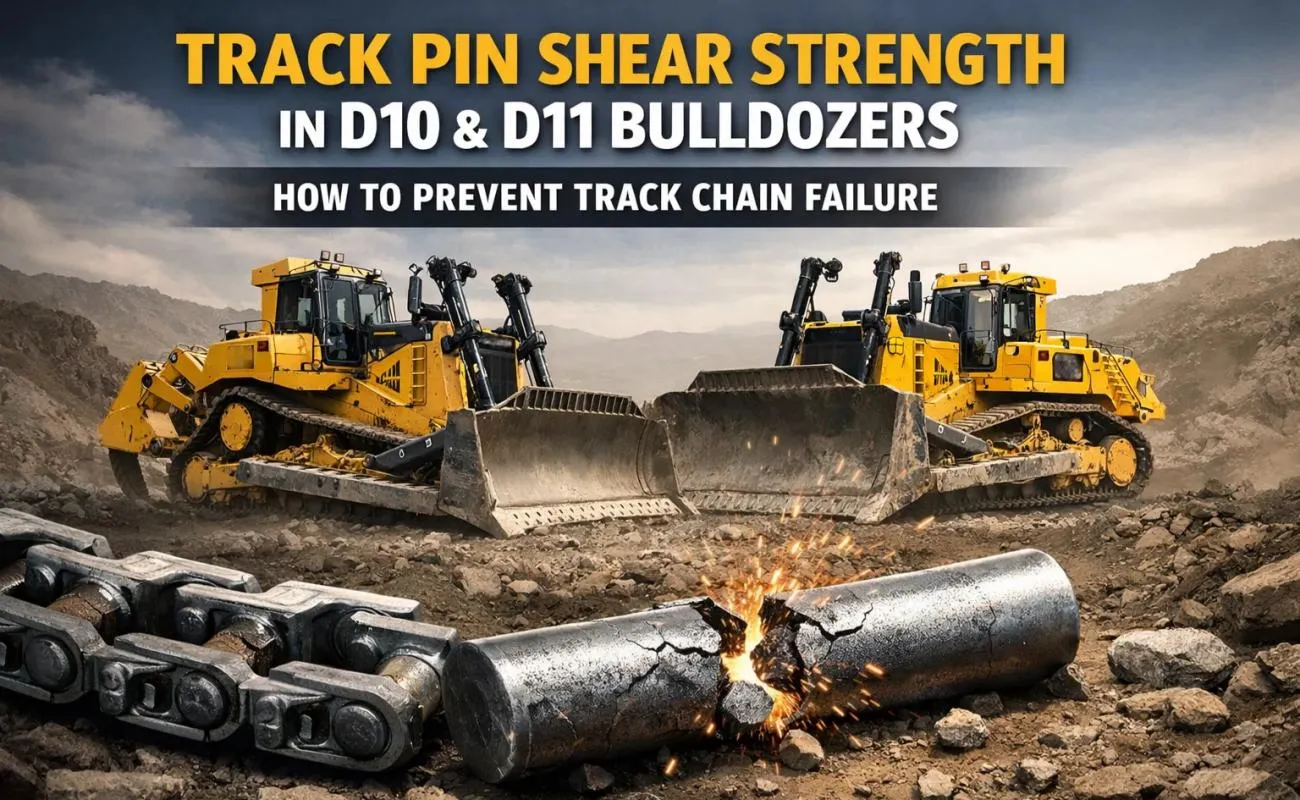
In large-scale mining and heavy earthmoving operations, ultra-heavy bulldozers such as Cat D10, D11, and Komatsu D475 operate under some of the most demanding ground conditions. With machine weights often exceeding 100 tons, these dozers generate enormous traction force and impact loads during pushing and ripping operations. Within the undercarriage system, the track pin may appear to be a small component, but it is one of the most critical parts subjected to concentrated shear stress. Every engagement between the track chain and sprocket, and every movement over rocks or uneven terrain, transfers high-impact loads directly through the pin.

If material strength or heat treatment is insufficient, the pin may experience bending, fatigue cracking, or even sudden fracture under prolonged heavy-duty conditions. In mining environments, such failures can lead to costly downtime that far exceeds the value of the component itself.

Why Ultra-Heavy Dozers Generate Higher Shear Stress

High Machine Weight and Extreme Pushing Resistance

Compared to medium-sized equipment, D10 and D11 class bulldozers operate with significantly higher loads due to:

  • Extremely high operating weight
  • Strong resistance when pushing rock, ore, or compacted soil

These factors combine to create much higher stress within the track system.

During operation, the sprocket continuously applies high torque to the track chain. This force is transmitted through the track links and pins, meaning each pin must repeatedly withstand bending and shear forces during every track cycle.

Impact Loads from Harsh Terrain

In mining benches, rocky slopes, and hard ground conditions, tracks are constantly subjected to irregular impacts when moving over uneven surfaces.

These sudden loads are concentrated at the link connection points, where the track pins are located. Over time, repeated impact stress can initiate micro-cracks if the material lacks sufficient strength or toughness, eventually leading to failure.

Balancing Shear Strength and Toughness

Hardness Alone Is Not Enough

Improving shear strength is not simply a matter of increasing hardness. In heavy-duty undercarriage components, excessive hardness can reduce material toughness, making the pin more prone to brittle fracture under shock loads.

A reliable track pin must achieve a balance between:

  • Surface hardness (for wear resistance)
  • Core toughness (for impact absorption)
  • Structural stability under cyclic loading

Surface Wear Resistance vs Core Flexibility

The outer layer of the pin must resist wear caused by constant contact with bushings, while the core must remain tough enough to absorb impact energy.

This is why heavy-duty track chains typically use deep heat treatment processes, allowing the surface to remain hard while maintaining a ductile core structure.

Heat Treatment Depth Determines Service Life

The Importance of Case Depth

In heavy undercarriage systems, the depth of heat treatment plays a critical role in durability.

If the hardened layer is too shallow:

  • Surface hardness may meet specifications
  • But wear quickly exposes the softer core
  • Resulting in accelerated wear and reduced lifespan

On the other hand, unstable heat treatment processes may create internal stress concentrations, increasing the risk of crack propagation under impact loading.

KINTON’s Heat Treatment Approach

To meet the demands of mining applications, KINTON PARTS uses:

  • Deep induction hardening
  • Strict tempering control

This process ensures:

  • High wear resistance on the surface
  • Strong, impact-resistant core structure

Such a combination allows the track pin to absorb more energy under heavy shock conditions and significantly reduces the risk of fatigue failure.

Structural Reinforcement for Heavy-Duty Track Chains

Beyond the Pin Itself

The performance of a track pin is also influenced by the overall structure of the track chain.

For large bulldozers, the chain system must maintain stable engagement under high traction forces. This requires optimization of:

  • Pin and bushing fit
  • Link structure strength
  • Manufacturing precision

Load Distribution Optimization

KINTON heavy-duty track chains are designed to distribute impact loads more evenly across the system. By improving the connection structure between pins and bushings, stress concentration on individual pins is reduced.

This structural reinforcement is particularly valuable in:

  • Mining operations
  • Quarry environments
  • Large-scale earthmoving projects

It significantly extends the service life of the entire track system.

Reliability Matters in Extreme Working Conditions

For ultra-heavy bulldozers such as D10, D11, and D475, machines often operate continuously under high-load conditions. Any failure in the undercarriage system can lead to expensive downtime and disrupt overall project productivity.

When selecting track chains, it is essential to consider:

  • Track pin shear strength
  • Heat treatment depth
  • Structural reliability of the chain system

For heavy-duty applications such as mining and large-scale earthmoving, choosing the right undercarriage components is critical to machine reliability.

KINTON PARTS supplies high-strength track chains, track pins, and complete undercarriage solutions designed for extreme working conditions.

If you are working with D10, D11, D475, or similar models, feel free to send your machine model or part number. Our team can recommend the most suitable configuration and support global delivery.