How a High-Precision Slewing Bearing Fixes Swing Wobble on Cat 320 Excavators
After more than 8,000 operating hours, many Cat 320 excavators begin to show a common problem: the upper structure feels unstable during rotation. Operators report that the swing no longer stops precisely where commanded, and when lifting heavy loads or working on slopes, the upper frame exhibits a noticeable wobble.
In most cases, the swing motor itself is not the real cause. The root problem lies inside the slewing bearing, where internal clearances and surface wear have exceeded acceptable limits
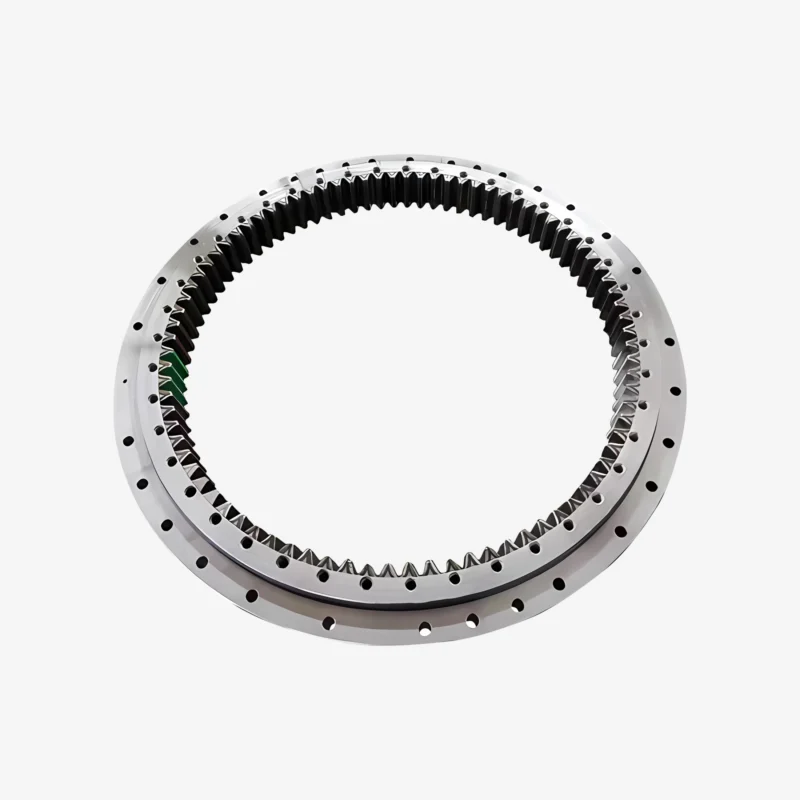
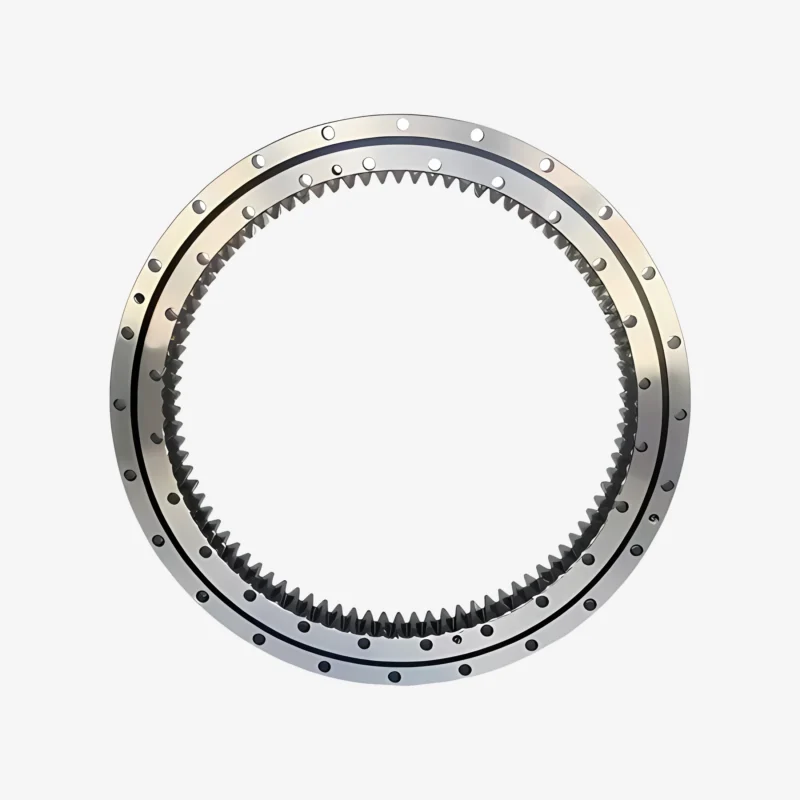
The slewing bearing is the only structural connection between the upper and lower frame of the excavator. It must simultaneously carry the machine’s full weight, resist overturning moments, and transmit rotational torque. When its internal geometry degrades, precise control is no longer possible.
Raceway Hardness Determines Load Stability
On medium-to-large excavators like the Cat 320, the slewing bearing operates under continuous axial load and alternating torque. If the raceway heat treatment is too shallow or hardness is inconsistent, rolling elements begin to form indentations and fatigue pits.
These microscopic defects gradually accumulate into measurable clearance. As load direction changes, the upper structure shifts slightly before settling, which operators experience as swing lag and instability
High-quality slewing bearings use deep induction-hardened raceways with stable hardness profiles to maintain geometric integrity even beyond 8,000 hours of service.
Gear Backlash Determines How Precisely You Can Stop
Many technicians focus only on load capacity, but gear accuracy is just as critical. The swing motor drives the slewing bearing through a pinion and ring gear. If backlash is not tightly controlled, a dead zone develops in the rotation.
As wear progresses, this dead zone becomes larger, causing the machine to hesitate before moving and then suddenly jump. This makes precise positioning during lifting or truck loading difficult and unsafe.
High-precision slewing bearings use tightly controlled gear tooth profiles and heat-treatment deformation control to ensure consistent backlash around the full circumference
Alignment Accuracy Protects the Swing Motor
The slewing bearing does more than support the structure—it also determines how the swing motor is loaded. If the bearing’s raceways or mounting faces are not concentric, the pinion gear runs under radial side-load.
This hidden misalignment accelerates wear on the swing motor’s bearings and gears, leading to noise, leakage, and eventual failure. On high-hour Cat 320 machines, restoring alignment with a precision slewing bearing also protects the swing motor from secondary damage
Why High-Hour Machines Need Higher-Precision Bearings
Once a machine exceeds 8,000 hours, its original manufacturing tolerances have largely been consumed by wear. Installing a low-grade slewing bearing at this stage only causes swing wobble to return quickly.
KINTON PARTS supplies slewing bearings for Cat 320 excavators using deep-hardened raceways and high-accuracy gear machining, designed to maintain rigid structural connection and smooth rotation even under heavy loads and frequent swing cycles
From Wobble Back to Stability
Swing instability is not just a comfort issue—it affects operating efficiency, structural life, and job-site safety. For service centers and fleet owners looking to extend machine life and reduce repeat repairs, choosing a true high-precision slewing bearing is the most direct and reliable way to restore Cat 320 swing performance.
When raceway integrity, gear accuracy, and alignment are brought back to proper standards, the excavator’s rotation returns to what it should be: stable, smooth, and precise