


How High-Precision Slewing Bearings Support Automated Excavator Operations


With the rapid adoption of intelligent construction technologies, excavators are shifting away from traditional manual control toward more precise and efficient automated and semi-automated operation. From automatic grading and precision swing alignment to vision-assisted excavation, all advanced functions rely on one critical foundation—the high-precision slewing bearing.
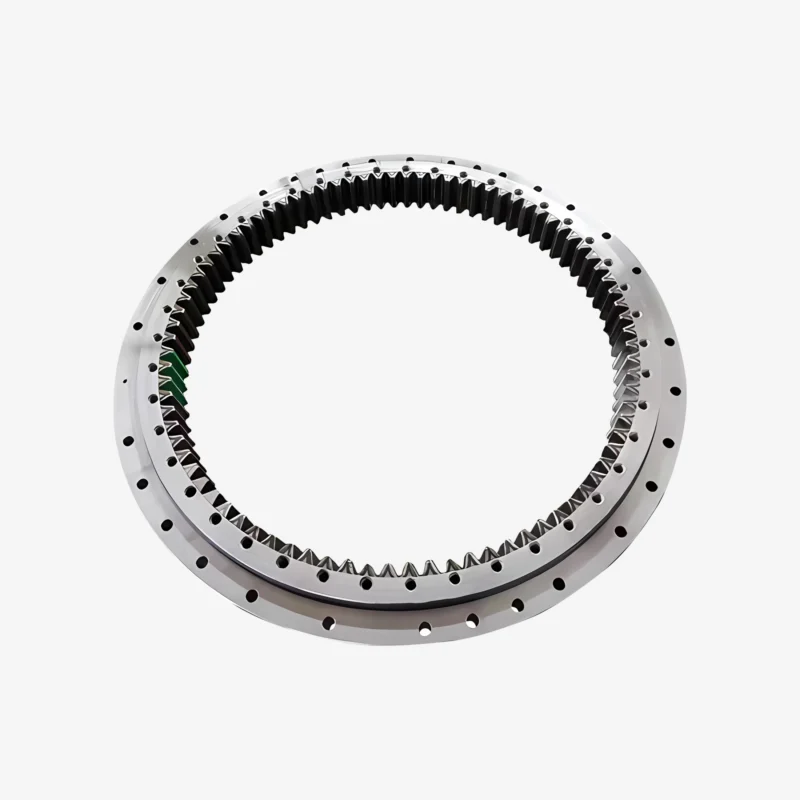
To many operators, a slewing bearing appears to be nothing more than a “rotating disc” that supports upper-structure rotation. But in intelligent machinery, its role goes far beyond that.
It not only bears the upper structure’s weight but also determines rotational accuracy, structural rigidity, anti-tilt capacity, and dynamic response—all of which directly impact whether automation systems can operate smoothly, accurately, and repeatedly.
What New Requirements Does Automation Demand from Slewing Bearings?
Unlike manual operation, intelligent systems place extremely high demands on precision. Automatic control algorithms rely on millimeter-level and arc-second–level posture calculations. Any small clearance, elastic deformation, or damping variation within the slewing mechanism is amplified by the system and ultimately affects accuracy.
(1) Higher Rotational Accuracy
Functions such as automatic grading, swing alignment, and 3D guidance require the slewing bearing to maintain stable precision throughout the entire 360° rotation—without noticeable runout, backlash, or fluctuations.
(2) Greater Structural Rigidity
Automated excavation often involves compound movements, such as rotating while digging. Under dynamic loads, the slewing bearing must not twist or deform significantly; otherwise, posture errors accumulate and affect the control system’s calculations.
(3) Stronger Resistance to Tilting and Side Loads
Automation does not reduce the likelihood of extreme working conditions, such as sloped operations or side digging. Under tilt loads, the slewing bearing must maintain stable support to ensure that positioning data remains accurate.
(4) Smoother Torque Transmission
Intelligent control requires smooth, predictable rotational response. This demands exceptionally high precision in raceway machining and gear accuracy to ensure linear torque transmission and avoid unstable “jerky” motion.
High-Precision Slewing Bearings
High-precision slewing bearings achieve their performance not simply through better materials, but through a system-level approach involving design, machining, heat treatment, and precision assembly.
(1) Precision Raceway Machining — The Core Foundation of Rotational Accuracy
Raceway geometry, roughness, and hardened depth determine the rolling stability of balls or rollers.
A high-precision raceway greatly reduces:
- Torque fluctuation
- Starting resistance
- Rotational runout
- Operational noise
This is why automated systems can achieve smooth, consistent rotation.
(2) Optimized Gear Machining — Essential for Dynamic Motion Control
Smart systems require the excavator to control rotation speed and angle precisely, even in extremely small increments.
High-precision gear machining ensures:
- Uniform tooth profile accuracy
- Stable pitch consistency
- Deep, stable surface hardening
- Reduced meshing noise
This allows the swing motor to output smooth, linear torque without “uneven speed” issues.
(3) High-Rigidity Structural Design — Built for Side Loads and Harsh Working Conditions
High-precision slewing bearings typically feature stronger forgings, thicker sections, and optimized raceway layouts to maintain shape under offset loads, excavation shocks, and oscillation.
Key benefits include:
- More stable posture feedback for automatic grading
- Less body sway in elevated operations
- Reduced “angle drift” during sloped digging
(4) Precision Assembly & Preload Control — Minimizing Backlash
Automation systems cannot tolerate excessive backlash.
Thus, high-precision slewing bearings require:
- Strict selection of balls/rollers
- Accurate filling quantity
- Controlled preload within extremely narrow tolerances
- Repeated measurement of backlash and runout
The manufacturing standard is significantly higher than that of conventional excavator bearings.
Key Roles of Slewing Bearings in Automated Construction Systems
(1) Automatic Grading
Slewing bearings provide stable rotational feedback, enabling the control system to accurately determine bucket position and achieve highly consistent grading accuracy.
(2) Automatic Swing Alignment
During repetitive loading cycles (e.g., truck loading), the machine auto-aligns to the optimal position.
This relies entirely on the slewing bearing’s rotational repeatability.
(3) 3D Guidance and Smart Excavation
Even small deviations matter.
A high-precision slewing bearing ensures linear, stable posture feedback, preventing position drift and keeping automated paths accurate.
(4) Intelligent Safety Systems
Modern excavators include restricted zones such as “no-go swing angles,” avoiding obstacles or power lines.
Accurate angle feedback from the slewing bearing is essential for reliable restriction logic.
Conclusion
As the construction industry continues toward automation and digital operation, the true foundation enabling these technologies is mechanical precision.
High-precision slewing bearings transform automated excavation from “functional” to stable, accurate, and reliable.
They serve as a critical structural link that supports the future of intelligent machinery.
For intelligent retrofits, heavy-duty applications, or high-precision construction needs, KINTON PARTS provides:
- High-precision slewing bearings
- Reinforced slewing bearings
- Custom gear and structure designs
- Specialized solutions for extreme conditions
We offer full technical support and selection guidance based on your equipment requirements.